- No — Assurance Vie is not the same as Life Insurance, despite the literal translation. It's France's most popular investment and savings wrapper, not a protection policy
- "Life Insurance" and "Life Assurance" aren't the same thing in the UK either — one's temporary cover, one's guaranteed for life — and neither is really a savings product
- An ISA's tax-free status doesn't survive the move to France. Once you're a French tax resident, ISA growth and withdrawals are taxable there
- A SIPP isn't "just a pension" for declaration purposes — it's also a foreign financial account that needs listing on Form 3916, separately from however you declare income from it
If you've ever heard of a product called "assurance vie" and assumed it meant life insurance, you're not alone. The literal translation is the trap. Functionally, the two products have almost nothing in common.
UK Life Insurance and Life Assurance: how France treats the payout
These are the simplest of the five, because there's usually nothing to declare year by year. A pure protection policy doesn't generate income or growth while it's running — there's no dividend, no interest, no fund value moving up and down that France could tax annually. The only event that matters is the payout itself, on death, and by then it's the beneficiary's situation that matters, not yours.
There's a caveat worth flagging rather than glossing over: some older UK whole-of-life policies were sold with an investment element bundled in, blurring the line between pure protection and savings. If your policy has any cash-in value you could access while alive, it's worth checking with a tax advisor whether that specific structure changes anything — this article covers the standard case, not every variant ever sold.
ISA: the one where "reinvested" doesn't mean "not yet taxable"
This is the distinction that catches people out the most, so it's worth being completely explicit about it.
In the UK, your ISA shields everything inside it — dividends, interest, capital gains — from tax, whether that money is paid out to you or automatically reinvested to buy more units in the fund. Because nothing is ever taxed inside an ISA, UK holders never have to think about the difference between "income that got reinvested" and "income that got paid to me." There isn't one, tax-wise. That's the entire point of the wrapper.
France doesn't recognise the wrapper at all. Once you're a French tax resident, your ISA is treated, for tax purposes, the same way as any other foreign investment account — and ordinary foreign investment accounts are taxed on an arising basis. That means the dividends and interest generated inside the account are taxable in the year they're generated, full stop. Whether that money lands in your pocket or gets automatically reinvested into more units of the same fund makes no difference to whether it's taxable. The reinvestment is just what you chose to do with already-taxable income — it doesn't pause the tax clock.
This is the opposite of how Assurance Vie works (see below), and it's precisely because people are used to one wrapper deferring everything that they assume the other one must too. It doesn't.
In practical terms: if your ISA holds a fund that pays dividends or interest and automatically reinvests them rather than paying out cash, you generally still need to identify and declare that income for the year it arose — not wait until you eventually sell or withdraw. Separately, any capital gain you realise when you do sell units is its own taxable event on top of that. These are declared via Form 2047 (foreign income) feeding into Form 2042, in the same dividends/interest sections used for any other foreign brokerage account. The account itself, separately, also needs listing on Form 3916 every year it exists — see the foreign accounts declaration guide. For the full PFU-vs-progressive and treaty mechanics specific to ISAs and SIPPs, see ISAs and SIPPs in France: What UK Expats Need to Know About Tax.
If you genuinely can't work out what income your ISA generated in a given year because the platform doesn't break it out clearly, that's a real and common problem — fund platforms are built for UK tax rules, not French ones, and they don't always make this easy to extract. It's worth raising directly with your platform's customer service for an income breakdown, rather than guessing.
SIPP: the account and the income are two separate jobs
A SIPP creates two distinct obligations, and conflating them is the single most common mistake.
A SIPP (Self-Invested Personal Pension) is a UK private pension wrapper where you choose and manage the investments inside it yourself rather than an insurer doing it for you. People often have one instead of — or alongside — a workplace or insurer-run pension.
The account's existence has to be declared every year on Form 3916, regardless of whether you're drawing anything from it. An untouched SIPP you're not yet accessing still goes on this form.
The income, when and if you do draw from it, is a separate declaration entirely — generally reported as pension income, with its own boxes and its own treaty treatment, distinct from the account-existence requirement.
This is genuinely different from the ISA situation above: a SIPP that simply grows in value while untouched typically doesn't trigger an annual income-tax event the way an ISA's reinvested dividends do. This is because pension wrappers are treated as deferred income until drawdown, not as an arising-basis investment account. So although the declaration for income tax is deferred until the time you take it, the existence declaration applies regardless. People who've correctly worked out that nothing's taxable yet sometimes wrongly conclude there's nothing to declare at all.
Assurance Vie: the deferral most other wrappers don't get
Unlike the ISA, an Assurance Vie is a French investment wrapper where growth is never taxed until withdrawal. The advantage for French residents is that alongside investment growth, it offers tax-favourable treatment on withdrawals after 8 years and reduced tax liability for named beneficiaries.
Tax is calculated at the time of withdrawal, based on the gain — not the full amount withdrawn. This is a genuine tax deferral, built into how the product is designed in French law.
That's precisely the opposite of the ISA situation: with an ISA, the wrapper itself offers no deferral once you're a French resident, because France simply doesn't recognise it as a wrapper at all. With Assurance Vie, the deferral is real, recognised, and central to why French residents use it as their primary long-term savings vehicle.
Quick reference table
| Wrapper | Where it's from | What it actually is | How France taxes it (in brief) |
|---|---|---|---|
| Life Insurance | UK | A pure protection policy. Pays out a lump sum if you die during a fixed term. No savings or investment growth involved. | Generally not a tax event in France — it's not an investment, so there's typically no gain to declare. |
| Life Assurance | UK | Whole-of-life protection. Pays out whenever you die, guaranteed — but still a protection policy, not an investment account. | Same as Life Insurance — a protection payout isn't investment income, so it typically falls outside the income-tax declaration. |
| ISA (Stocks & Shares or Cash) | UK | A tax-free wrapper for savings or investments, shielding growth and withdrawals from UK tax. | France doesn't recognise the ISA wrapper. Growth and withdrawals are taxable here, usually under the PFU flat rate or progressive scale. The account itself also needs declaring on Form 3916. |
| SIPP | UK | A Self-Invested Personal Pension — a flexible, DIY-style private pension you manage yourself. | Pension income is taxed when drawn. Separately, the account's existence — whether you're drawing from it or not — must be declared on Form 3916. |
| Assurance Vie | France | Despite the name, this is an investment and savings wrapper, not a protection policy. It's the most common long-term savings vehicle for French residents. | You're taxed only on the gain when you withdraw, not the full amount. S1 holders get reduced social charges on the gain, same as other investment income. |
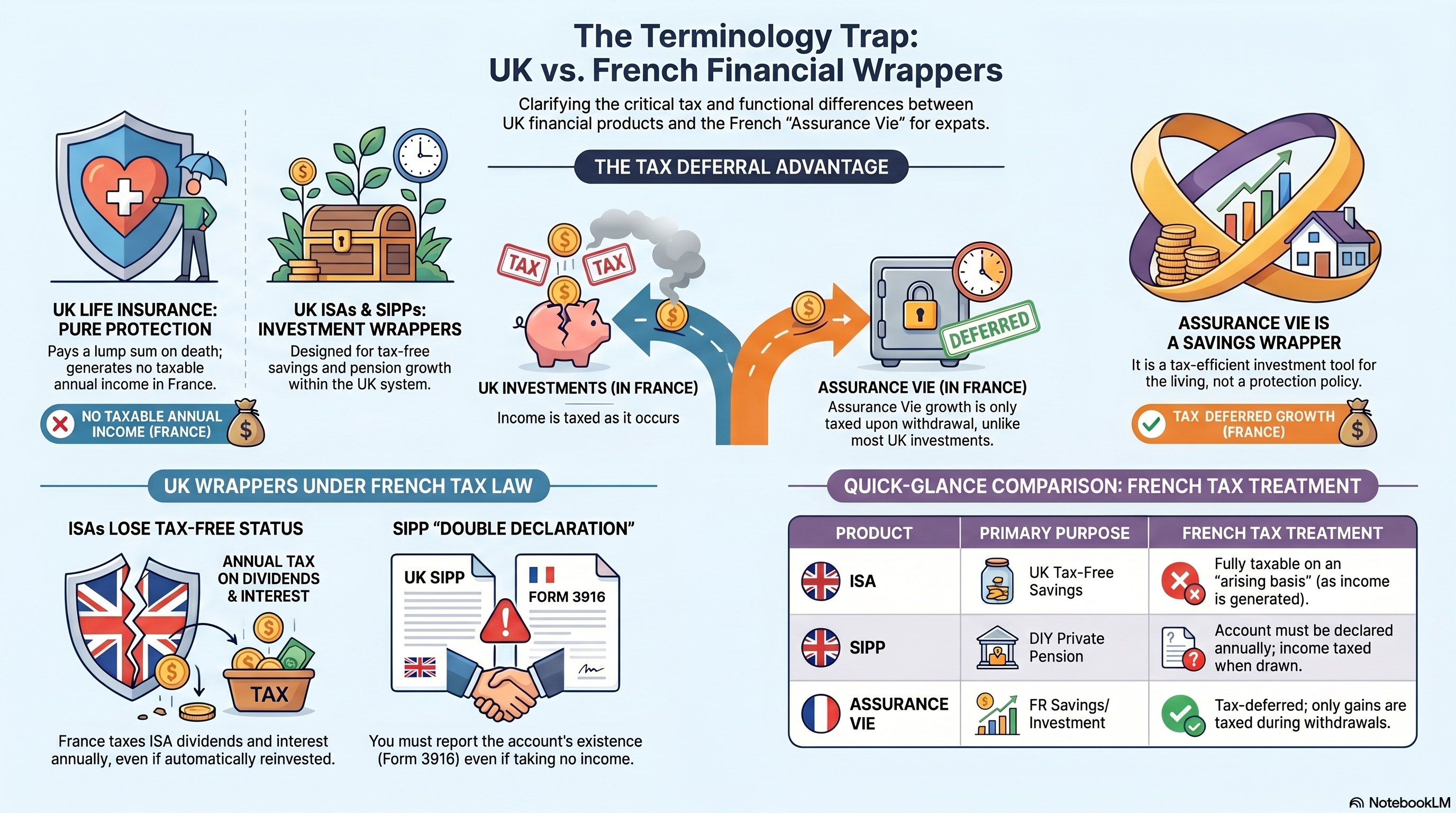
Why this matters before you get to the tax detail
Each of these products has its own dedicated tax-treatment article on this site, because the mechanics genuinely differ — boxes, forms, whether social charges apply, whether an S1 changes anything. But all of that only makes sense once you know what you're actually holding. Calling a SIPP "just a pension," an ISA "tax-free," or an Assurance Vie "like my UK life insurance" sends you looking in the wrong direction before you've even opened a form.
Taxpert's filing assistant helps you work out which accounts need declaring and on which forms. Try Taxpert →
Frequently Asked Questions
Is Assurance Vie the same as UK life insurance?
No, despite the literal translation. UK life insurance is a protection policy that pays out on death. Assurance Vie is an investment and savings wrapper that French residents use to grow and access money during their lifetime — it has far more in common with a flexible investment account than with a protection policy.
Why is it called "Assurance Vie" if it isn't life insurance?
Historically the product did originate from a life-cover structure, and many policies still pay out a death benefit alongside their savings function. But over time it evolved into primarily a savings and investment wrapper, and that's how the vast majority of holders use it today — the name simply never caught up with what the product became.
If my ISA's dividends are automatically reinvested rather than paid out, do I still need to declare them?
Yes. France taxes ISA income on an arising basis — meaning it's taxable in the year it's generated, regardless of whether it's paid out to you or automatically reinvested into more units. The reinvestment changes what you did with the money, not whether it was already taxable.
Does my ISA stay tax-free once I'm a French tax resident?
No. France doesn't recognise the ISA wrapper, so growth and withdrawals become taxable here once you're tax resident, generally under the same rules as other investment income.
Do I need to declare my SIPP even if I'm not drawing from it yet?
Yes. The SIPP itself is a foreign financial account and needs declaring on Form 3916 every year it exists, separately from however any income you do draw is declared.
Is a payout from my UK life insurance or life assurance policy taxable in France?
Generally, a protection-policy payout isn't treated as investment income, since there's no underlying investment generating a gain. This is a general guide rather than a definitive answer for your specific policy — if you're unsure, it's worth checking the policy structure with a tax advisor.
Does having an S1 reduce the tax on my Assurance Vie?
It can reduce the social charges on the gain specifically, in the same way it does for other investment income — but it doesn't affect the income tax portion. The mechanics depend on your household situation.